Children's Nursing · Cardiovascular
Cardiovascular System & Assessment
How the heart works, where blood flows, what to check at the bedside, and which signs mean a child needs help early.
Save for later
Student note
Perfusion means how well blood is reaching tissues. Preload means how much blood fills the ventricle before it squeezes. Afterload means the resistance it has to push against. Contractility means how strong the squeeze is. A shunt means blood is taking an abnormal route. A murmur is an extra sound caused by turbulent blood flow. Cyanosis means a blue tinge caused by too little oxygenated blood reaching the tissues.
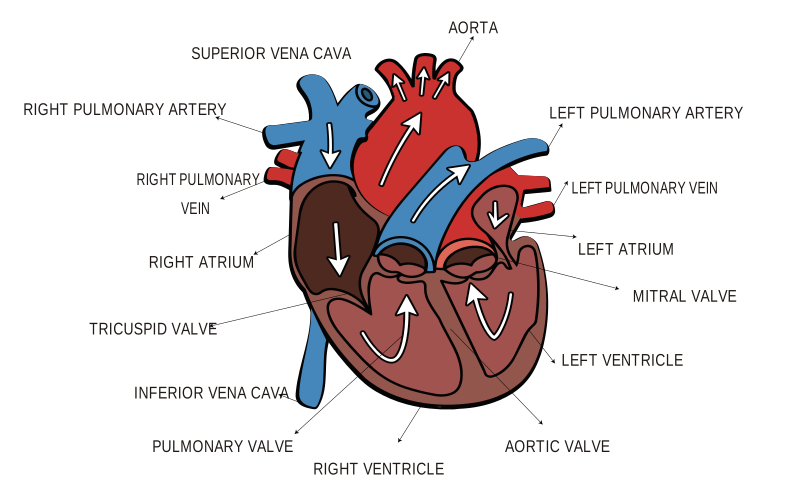
Tap any dot to see what that part does, or press “Follow the blood” to watch one full loop draw itself.


Flow order
Body → Right heart → Lungs → Left heart → Body. SVC/IVC → RA → RV → lungs → LA → LV → aorta.
Core formula
Cardiac Output = Heart Rate × Stroke Volume. Children compensate with heart rate before blood pressure drops.
Golden rule
A normal blood pressure does not rule out shock in a child. Hypotension is late; cold, pale, slow refill is early.
Vessel rule
Artery = away from heart, vein = towards heart. The pulmonary vessels are the classic exceptions.
Heart Anatomy
What are the chambers, valves, and walls that make up the heart?
Chambers
- Right atrium: receives deoxygenated blood via SVC/IVC
- Right ventricle: pumps blood to lungs
- Left atrium: receives oxygenated blood from lungs
- Left ventricle: main pressure pump to body
Valves
- Tricuspid: RA to RV
- Mitral: LA to LV
- Pulmonary: RV exit to pulmonary artery
- Aortic: LV exit to aorta
Wall layers
- Pericardium: protective sac
- Myocardium: contracting muscle layer
- Endocardium: smooth inner lining
- Septum separates right and left sides
Support structures
- Papillary muscles inside ventricles
- Chordae tendineae attach to AV valves
- Pectinate muscles: ridges in atria
- Trabeculae carneae: ridges in ventricles
Clinical pearl
The heart is built the same basic way in children and adults, but children have less reserve. That means heart problems often show up first as fast heart rate, poor feeding, colour change, or slow capillary refill rather than as a dramatic low blood pressure straight away.
Blood Flow & Vessels
Where does blood travel and how do the circuits connect?
Pulmonary circuit
- Right ventricle to lungs to left atrium
- Lower-pressure circuit
- CO₂ released, O₂ picked up
- Pulmonary arteries carry deoxygenated blood
Systemic circuit
- Left ventricle to body to right atrium
- Higher-pressure circuit
- O₂ and nutrients delivered to tissues
- CO₂ and waste carried back
Vessel types
- Arteries: thick, muscular, away from heart
- Veins: thinner, valves, towards heart
- Capillaries: one cell thick, exchange happens here
- Pulmonary vessels are the classic exceptions
Exchange at capillaries
- O₂ and nutrients move out to tissues
- CO₂ and wastes move into blood
- Walls are single-layer endothelium
- Thin wall is why exchange can happen
Clinical pearl
Artery means away from the heart, not automatically oxygenated. Vein means towards the heart, not automatically deoxygenated. That is why the pulmonary artery and pulmonary veins are the classic exceptions.
Fetal Circulation & Transition
How does blood flow before birth and what changes when the baby is born?
Before birth
- Placenta does gas exchange, not lungs
- Fetal blood is mixed, not fully oxygenated
- Circulation designed to bypass the lungs
- Umbilical vein brings O₂-rich blood in
Fetal shunts
- Ductus venosus: bypasses the liver
- Foramen ovale: RA to LA, bypasses lungs
- Ductus arteriosus: PA to aorta, bypasses lungs
- Umbilical arteries return blood to placenta
After birth
- First breaths expand lungs, blood flow rises
- Left atrial pressure rises, foramen ovale closes
- Falling prostaglandins close ductus arteriosus
- Ductus venosus closes as placental flow stops
Clinical relevance
- PDA: ductus arteriosus stays open
- Persistent cyanosis needs urgent assessment
- Brief blue tinge in hands/feet can be normal
- Central cyanosis after birth is not normal
Red flags
Cardiac Cycle & Output
How does the heart fill, squeeze, and maintain flow to the body?
Cardiac cycle phases
- Diastole: ventricles relax and fill
- Heart gets most of its own blood supply here
- Atrial systole: final top-up of ventricles
- Ventricular systole: blood pumped out
Cardiac output
- CO = HR x SV
- Preload: how full the ventricle is
- Afterload: resistance to push against
- Contractility: how strong the squeeze is
Why HR matters in children
- Children cannot boost SV as much as adults
- Compensate by increasing heart rate first
- Tachycardia is an early compensating sign
- Bradycardia in a sick child is very worrying
Why diastole matters
- Not just a resting phase
- Ventricles fill during diastole
- Very fast HR shortens filling time
- Can reduce SV and worsen a sick child
Red flags
Clinical pearl
Children can look as if they are compensating, then suddenly get much worse. Do not wait for low blood pressure before escalating. Tachycardia and prolonged capillary refill may appear long before hypotension.
Conduction System & ECG
How does the electrical signal travel and what does each part of the ECG show?
Electrical pathway
- SA node: natural pacemaker in RA
- AV node: brief delay for filling
- Bundle of His to bundle branches
- Purkinje fibres spread through ventricles
ECG waves
- P wave: atrial depolarisation
- PR interval: signal travelling to ventricles
- QRS complex: ventricular contraction
- T wave: ventricular repolarisation
Cell properties
- Cardiomyocytes: working muscle cells
- Contract over and over automatically
- Intercalated discs link cells together
- Signals pass quickly for coordinated squeeze
Clinical link
- Normal sinus rhythm: SA node leads
- ECG trace does not always mean effective output
- PEA: trace but no pulse
- ST segment matters in advanced interpretation
Paediatric Assessment & CHD
What should you check at the bedside and what are the key congenital patterns?
Look first
- Colour, interaction, alertness
- Breathing effort, warm and well perfused?
- Use trends, not isolated numbers
- Think compensation before deterioration
Key observations
- HR against age norms
- Pulse quality: central and peripheral
- CRT: usually under 2–3 seconds
- BP useful but hypotension is late
Perfusion signs
- Colour and temperature of peripheries
- Urine output ~1 ml/kg/hr guide
- General appearance and feeding
- Pale, mottled, cold = poor perfusion
Congenital patterns
- Acyanotic: L-to-R shunt, may not look blue
- Cyanotic: deoxygenated blood to body, blue
- ASD, VSD, PDA = common acyanotic
- TOF, TGA = common cyanotic
Red flags
Clinical pearl
Warm, pink skin, quick capillary refill, good urine output, and strong pulses all suggest perfusion is okay. Cold, pale, mottled, sleepy, or poorly responsive children should make you think poor perfusion early, even if the blood pressure has not dropped yet.
Blood Flow Path
One full circuit: body → right heart → lungs → left heart → body
Heart Structure Reference
| Structure | What it is | Why it matters |
|---|---|---|
| Right atrium | The chamber that receives oxygen-poor blood coming back from the body through the superior and inferior vena cava. | Think of it as the heart's receiving room on the right side before blood moves down into the right ventricle. |
| Right ventricle | Pumps oxygen-poor blood through the pulmonary valve into the pulmonary arteries. | Its job is to send blood to the lungs. It does not need as much muscle as the left ventricle because the lungs are a lower-pressure circuit. |
| Left atrium | Receives oxygen-rich blood coming back from the lungs through the pulmonary veins. | It passes that freshly oxygenated blood into the left ventricle ready to be pumped to the body. |
| Left ventricle | Pumps oxygen-rich blood through the aortic valve into the aorta and out to the body. | This is the main pressure pump of the heart, so it has the thickest wall and does the hardest physical work. |
| Atrioventricular valves | The tricuspid valve sits between the right atrium and right ventricle. The mitral valve sits between the left atrium and left ventricle. | They act like one-way doors, keeping blood moving forward instead of letting it fall back into the atria when the ventricles squeeze. |
| Semilunar valves | The pulmonary valve sits at the exit to the pulmonary artery. The aortic valve sits at the exit to the aorta. | They stop blood running backwards into the ventricles once it has been pumped out. |
| Septum | The interatrial and interventricular septa are the walls separating the right and left sides of the heart. | They keep oxygen-poor and oxygen-rich blood apart in normal circulation. |
| Major vessels | The SVC and IVC bring blood back from the body. The pulmonary arteries take blood to the lungs. The pulmonary veins bring it back. The aorta sends it out to the body again. | These are the big routes connecting the heart to the lungs and the rest of the body. |
Pulmonary and Systemic Circuits
| Circuit | Path | Main job | Clinical note |
|---|---|---|---|
| Pulmonary circulation | Right ventricle -> lungs -> left atrium | Moves blood to the lungs so carbon dioxide can be released and oxygen can be picked up. | Lower-pressure circuit. |
| Systemic circulation | Left ventricle -> body -> right atrium | Delivers oxygen and nutrients to tissues, then brings carbon dioxide and waste products back. | Higher-pressure circuit. |
Clinical pearl
In the lungs, blood flows past the alveoli, picks up oxygen, and drops off carbon dioxide. Out in the tissues, the opposite happens: oxygen and nutrients leave the capillaries and move into cells, while carbon dioxide and waste move back into the blood. This works because capillary walls are extremely thin and lined by a single layer of endothelial cells.
Blood Vessel Types
| Vessel type | Key features | Why it matters |
|---|---|---|
| Arteries | Carry blood away from the heart. Thick, muscular, elastic walls. | They are built for higher pressure. The pulmonary artery is the main exception that carries oxygen-poor blood. |
| Veins | Carry blood towards the heart. Thinner walls, lower pressure, and often valves. | They act as the lower-pressure return system. The pulmonary veins are the main exception that carry oxygen-rich blood. |
| Capillaries | Microscopic vessels linking the arterial and venous sides. Walls are only one cell thick and lined by endothelium. | Their very thin wall is why exchange can happen here: oxygen and nutrients move out to tissues, while carbon dioxide and wastes move back into the blood. |
Fetal Circulation Reference
| Structure | Job before birth | What happens after birth |
|---|---|---|
| Umbilical vein | Brings the most oxygen-rich blood available from the placenta to the fetus. | Closes after the cord is clamped because the placenta is no longer part of the circulation. |
| Umbilical arteries | Carry blood from the fetus back to the placenta. | Close once placental circulation ends. |
| Ductus venosus | Lets much of the blood from the umbilical vein bypass the liver. | Closes after birth as normal liver circulation takes over. |
| Foramen ovale | An opening between the right and left atria that helps blood bypass the lungs before birth. | Usually closes functionally soon after birth when pressure rises on the left side. |
| Ductus arteriosus | Connects the pulmonary artery to the aorta so much of the blood from the right ventricle can bypass the lungs. | Normally closes over the first days to weeks. If it stays open, that is a patent ductus arteriosus (PDA). |
Clinical pearl
A brief blue tinge can happen during immediate transition, especially in the hands and feet, but persistent central cyanosis after birth is not something to brush off. It may mean the normal switch from fetal to newborn circulation is not happening properly, or that there is a serious cardiac or respiratory problem underneath.
Stroke Volume Determinants
| Determinant | Meaning | Clinical relevance |
|---|---|---|
| Preload | How full the ventricle is before it squeezes. | If less blood comes back to the heart, for example with dehydration or blood loss, there is less to pump out. |
| Afterload | How hard it is for the ventricle to push blood out. | If afterload rises, the ventricle has to work harder to eject blood. |
| Contractility | How strong the heart muscle squeeze is. | If contractility is poor, the heart squeeze is weaker and cardiac output can fall. |
Clinical pearl
Diastole is not just the resting phase. It is the time when the ventricles fill and when much of the heart muscle itself receives its own blood supply. If the heart rate becomes very fast, filling time gets shorter, which can reduce stroke volume and make a sick child look worse quite quickly.
ECG Reference
| ECG part | What it represents | Why it matters |
|---|---|---|
| P wave | The electrical activity that makes the atria contract. | A simple way to remember it is: P wave = atria are being triggered to squeeze. |
| PR interval | The signal travelling from the atria, through the AV node, towards the ventricles. | It includes the normal AV-node delay that gives the ventricles time to fill. |
| QRS complex | The electrical activity that triggers ventricular contraction. | This is the big squeeze of the ventricles. |
| ST segment | The short section after the ventricles have been triggered and before they reset. | It matters clinically, especially in more advanced ECG interpretation, but at this level it is enough to recognise where it sits on the trace. |
| T wave | The ventricles resetting electrically. | After the T wave, the ventricles are ready for the next beat. |
Clinical pearl
A normal sinus rhythm means the electrical signal starts in the SA node and follows the usual route. Most of the time electrical activity and a pulse go together, but not always. Pulseless electrical activity is the reminder that an ECG trace does not automatically mean the child has an effective circulation.
Paediatric Circulatory Assessment
| Assessment | What it tells you | Key points |
|---|---|---|
| Heart rate | How fast the heart is beating. | Compare it with age-specific norms. A high heart rate can be pain, fever, anxiety, dehydration, sepsis, or early circulatory compromise. A slow heart rate in a sick child is more worrying and can be late. |
| Pulse quality and equality | How strong the pulses feel and whether both sides match. | Check central and peripheral pulses. Weak, thready, unequal, or absent pulses can point to poor cardiac output, shock, or an obstructive problem. |
| Capillary refill time | A bedside sign of peripheral perfusion. | Usually under 2 to 3 seconds. A prolonged refill time should always be interpreted alongside temperature, colour, pulse quality, and the overall child. |
| Colour and temperature | How well the circulation is supporting the skin and peripheries. | Pale, mottled, cyanotic, or cold peripheries suggest poor perfusion or hypoxaemia. |
| Blood pressure | Pressure generated by cardiac output against vascular resistance. | Useful, but hypotension is a late sign in children. A child can be shocked with a blood pressure that still looks okay. |
| Urine output | A practical marker of renal perfusion. | Around 1 ml/kg/hour is a useful guide. Reduced urine output can mean poor perfusion, dehydration, or both. |
| General appearance | What the child looks like before you even touch them. | Alertness, tone, interaction, cry, behaviour, and feeding matter. Always assess trends, not isolated numbers. |
Pulse Points
Apical pulse
- Best for counting heart rate accurately in infants and small children.
Brachial pulse
- Useful in infants and for quick circulation checks.
Radial pulse
- Common in older children if perfusion is reasonable.
Femoral pulse
- Important when checking central perfusion and comparing upper with lower limb pulses.
Posterior tibial / dorsalis pedis pulse
- Helpful when assessing peripheral perfusion in the feet.
Bedside Patterns
| Bedside pattern | What you may notice | What it may mean |
|---|---|---|
| Low cardiac output picture | Pale or mottled skin, cool peripheries, prolonged capillary refill, weak pulses, reduced urine output | Forward flow to tissues is not meeting the child’s needs well enough. |
| Pulmonary overcirculation / heart failure picture | Tachypnoea, increased work of breathing, sweating with feeds, poor weight gain, tiring easily | Too much blood is going to the lungs or the heart is struggling to cope with the workload. |
| Cyanotic picture | Central cyanosis, persistently low saturations, poor colour despite oxygen, abnormal pre- and post-ductal difference | Oxygen-poor blood may be reaching the systemic circulation or pulmonary blood flow may be severely limited. |
Congenital Heart Disease
| Type | Meaning | Examples |
|---|---|---|
| Congenital heart disease | Present from birth because the problem developed while the baby was forming in the womb, often in the first 6 to 8 weeks of pregnancy. | ASD, VSD, PDA, Tetralogy of Fallot, Transposition of the Great Arteries |
| Acquired cardiac disease | Develops after birth rather than during fetal development. | Kawasaki disease, cardiomyopathy, acquired arrhythmias, endocarditis |
| Pattern | What it means | Examples |
|---|---|---|
| Acyanotic defects | Usually involve left-to-right shunting or obstruction, so the child may not look blue at first. | ASD, VSD, PDA, coarctation of the aorta |
| Cyanotic defects | Allow oxygen-poor blood into the systemic circulation or greatly reduce blood flow to the lungs, so the child may look blue. | Tetralogy of Fallot, Transposition of the Great Arteries, tricuspid atresia |
Clinical pearl
Many congenital heart defects develop very early in pregnancy, often before someone even realises they are pregnant. That is why defects such as ASD, VSD, PDA, TOF, and TGA are usually taught alongside fetal development and transition at birth.
ASD (Atrial Septal Defect)
Exam tip
Do not stop at saying “a hole in the heart.” A stronger answer is: an ASD is a defect in the interatrial septum that usually causes a left-to-right shunt, so extra blood ends up on the right side of the heart and then goes to the lungs.
| Step | What is happening |
|---|---|
| Defect | An ASD is a gap in the wall between the two atria, so blood can pass between them when it should not. |
| Pressure gradient | Pressure is usually higher in the left atrium, so blood usually moves from left to right across the defect. |
| Right-sided volume load | That extra blood ends up loading the right atrium and right ventricle, so the right side has more volume to handle than normal. |
| Pulmonary overcirculation | The extra volume then gets pumped to the lungs, so pulmonary blood flow rises and the lungs can become congested. |
| Why infants become symptomatic | Infants have less reserve than older children. If both breathing and feeding become harder work, they tire quickly and may not grow well. |
Signs and Symptoms of ASD in Infants
| Sign | Why it can happen |
|---|---|
| Poor feeding | The infant has to suck, swallow, and breathe at the same time while already working harder to breathe and circulate blood. |
| Sweating during feeds | Feeding is hard physical work for an infant, so the extra effort can make them sweaty. |
| Tachypnoea | If the lungs are getting too much blood, breathing becomes less efficient and the infant compensates by breathing faster. |
| Recurrent respiratory symptoms | Extra blood flow to the lungs can make them wetter and more prone to congestion-like symptoms or repeated chest problems. |
| Poor weight gain or faltering growth | Intake drops while energy expenditure rises, so growth can suffer. |
| Fatigue | The heart and lungs are both working harder, so the infant tires more quickly than expected. |
| Murmur | Often caused by the extra blood flow moving turbulently across the right side of the heart and pulmonary valve, rather than by the hole itself. |
Feeding Difficulties in Infants with ASD
Clinical pearl
Feeding is almost like an exercise test for an infant. If they become breathless, sweaty, pause often, or only take tiny volumes, that can reflect the extra work their heart and lungs are doing, not just simple tiredness.
Feeding is work
- For infants, a feed is active work. They have to coordinate sucking, swallowing, and breathing while still maintaining oxygenation and circulation.
Pulmonary overcirculation matters
- If extra blood is going to the lungs, breathing is harder work and feeds are more likely to be stop-start.
Cardiac workload rises
- The heart is already handling extra volume, so a long feed can be enough to make the infant visibly tired.
Growth can falter
- Smaller feeds, longer feeds, sweating, and higher energy use all make steady weight gain harder.
What to assess during feeds
How much the infant takes. How long the feed takes. Whether they pause often or look breathless. Whether they sweat, tire, or fall asleep early. Weight trend over time. Hydration status and urine output.
Clinical pearl
A murmur tells you blood is moving turbulently somewhere, but it does not tell you by itself how well the child is coping. Always match the sound with the clinical picture: feeding, colour, work of breathing, pulse quality, growth, and perfusion matter just as much.
Investigations
| Investigation | What it shows | Why it is useful |
|---|---|---|
| ECG | Heart rhythm, rate, conduction patterns, and signs of chamber strain. | A useful first test when you are thinking about rhythm problems or structural heart disease. |
| Echocardiogram with Doppler | Heart anatomy, valve function, chamber size, and the direction of blood flow. | The main test for confirming ASD and looking at how blood is moving through the heart. |
| Chest X-ray | Heart size and the appearance of the lungs. | May show an enlarged heart or signs that there is too much blood flow going to the lungs. |
| Pre- and post-ductal oxygen saturations | Comparison of right-hand and foot saturations. | Useful when you are thinking about transitional-circulation problems or duct-dependent heart disease. |
| Cardiac catheterisation | Direct pressure measurements and detailed anatomical information. | Used when the team needs more detailed information or is planning an intervention. |
Clinical pearl
If you are worried now: use A-E, escalate early, keep the child warm and calm, reassess often, and support feeding and hydration while senior help is on the way. If perfusion looks poor, do not wait for a low blood pressure before acting.
Quick Mnemonic Recap
Flow rule
Body → Right heart → Lungs → Left heart → Body
Core formula
CO = HR × SV
ASD pattern
Left-to-right shunt → right-sided volume load → more blood to lungs
Early vs late
Hypotension is late; cold, pale, slow refill is early
Quick self-test
Sources & References
Waugh A & Grant A (2018) — Ross and Wilson Anatomy and Physiology in Health and Illness (13th edn)NICE (2018) — Chronic heart failure in adults: diagnosis and management (NG106)British Heart Foundation — Heart conditions — professional informationResuscitation Council UK (2021) — 2021 Resuscitation GuidelinesAlso practise with
Keep the momentum
One useful next step beats opening twelve new tabs.
Practise next
Use this page, then move straight into practice.
You have already done the reading. The best next move is a short practice block or one related guide, while the details are still fresh.